
Three Centuries of Craftsmanship: How Our Family Became Custodians of Fossilized Wood
True luxury is rarely created overnight. It is usually the outcome of patience, repetition, and a long line of people who chose to refine the same craft rather than chase the trend of the moment. The story behind these petrified wood bathtubs is, at its core, a story about such a lineage—one that has spent generations listening to what ancient stone has to say.
1/8/20264 min read
A lineage devoted to stone and story
Long before petrified wood became a coveted material in contemporary interiors, it was an object of curiosity for collectors, geologists, and artisans who sensed both its scientific and artistic value. Over centuries, families and workshops in select regions developed a deep familiarity with this fossilized timber, learning where the most extraordinary specimens were likely to be found and how to handle them without compromise.
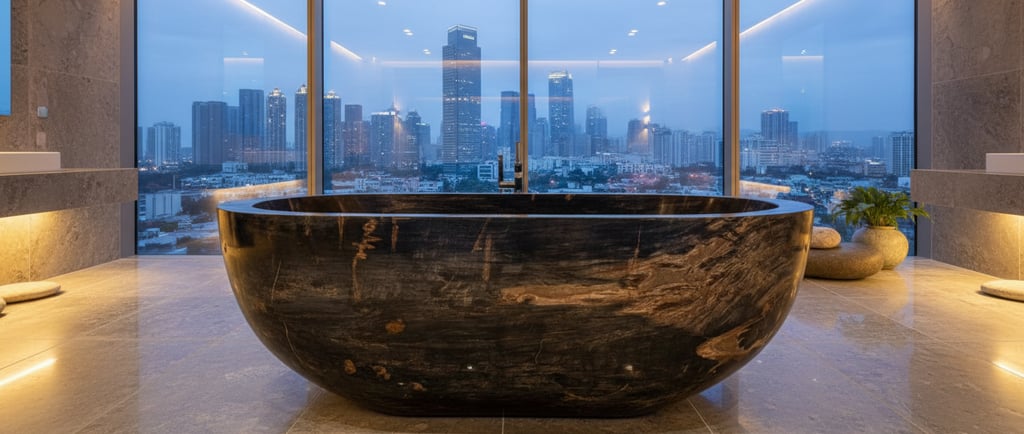
Within this tradition, craftsmanship is not limited to technical skill; it also includes discernment. Knowing which block to walk away from is as important as knowing which one to acquire. The result of that discipline is a very small number of pieces that are worthy of becoming functional sculptures—tubs that can confidently enter museum‑level collections, private estates, and flagship suites in world‑class resorts.
Learning to read the fossil
Working with petrified wood begins long before any tool touches the surface. A trained eye can read color shifts, grain direction, and subtle fractures that reveal how a piece has formed over time. Warm browns and golds may signal one mineral composition, while greys, blacks, and inky blues suggest another; the distribution of these tones helps determine where the most expressive part of the bathtub should be positioned.
At the same time, structural integrity must be carefully assessed. Hidden voids, hairline cracks, and areas of softer infill need to be identified early so that the final piece is not only beautiful but also stable and safe in daily use. Very few artisans globally combine this geological understanding with the sculptural instinct required to imagine, from a raw block, the finished form of a bath that will host thousands of hours of quiet, personal ritual.
The art of transforming brittle stone into living forms
Once a block has been selected, the challenge is to reveal the shape within it without disturbing its essential strength. Specialized equipment is used to make the first cuts, but the most decisive work remains in the hands of experienced artisans, who guide each stage of hollowing, refining, and softening the interior. Because the material is both dense and potentially brittle, aggressive removal is never an option; every pass is deliberate.
Edges are eased, contours are tuned for comfort, and surfaces are gradually brought from rough to satin to luminous, revealing the inner life of the fossil in layers. A finished tub holds an unusual tension: it appears monumental yet feels gentle to the touch, like stone that has already lived several lifetimes before being invited into a home. This combination is what differentiates true craftsmanship from mere fabrication.
Craftsmanship as a spiritual practice
Spending one’s days shaping material that predates human history inevitably changes a maker’s relationship to time. Many artisans describe the work as meditative: days structured not by notifications or deadlines, but by the rhythm of tools moving across stone and the slow emergence of a form that feels “right.” The goal is not to impose an idea on the material but to collaborate with it, allowing the natural grain and mineral flows to guide decisions.
Clients often sense this when they encounter a completed piece. Collectors speak of a calm presence, spa owners describe a “healing energy” in rooms centered around petrified wood, and designers note how guests instinctively reach out to touch the surface. That emotional response is one of the clearest signs that the craftsmanship has succeeded: the tub is no longer just an object, it is a quiet companion in the space.
From guardianship to global connoisseurs
As demand for truly singular pieces has grown among ultra‑high‑net‑worth homeowners, architects, and resort developers, this craft has naturally moved onto a global stage. Petrified wood now appears in flagship bathrooms, private spa suites, and signature residences where clients expect every element to tell a story and hold its value over time. For these clients, provenance, ethical sourcing, and continuity of expertise matter as much as aesthetics.
This is why long‑standing workshops and family‑led studios are so highly sought after. Their archives of knowledge—where the finest deposits were historically found, how certain stones behave under stress, which finishes perform best in intensive hospitality environments—cannot be replicated quickly. When a client chooses a bathtub emerging from such a lineage, they are not only investing in a striking centerpiece but also in a network of experience that stands behind it.
What this legacy means for today’s buyer
For a contemporary collector or property owner, heritage translates into reassurance. It means that every piece has been evaluated with the same strict eye that previous generations used for museum‑grade fossil specimens and semi‑precious stone commissions. It also means that guidance on installation, maintenance, and long‑term care is shaped by decades of practice rather than guesswork.
When a petrified wood bathtub enters a residence or resort, it arrives with a story already written—one that began in an ancient forest, passed through the hands of multiple generations of artisans, and now continues in a single, carefully designed space. For many owners, that continuity of narrative is as valuable as the physical object itself.
A discreet invitation
For those who feel drawn to this blend of legacy, geology, and design, a private consultation is the most natural way to begin. A focused conversation can explore the property, intended use, and architectural context, then pair these with specific specimens and forms that align with the client’s vision. From there, a tailored process—covering selection, logistics, and long‑term stewardship—ensures that the bathtub chosen today will feel as relevant and resonant decades from now as it does on the first evening it is filled.
Transforming ancient fossilized wood into the world's most exclusive luxury bathtubs and wellness sanctuaries.
Terms
Links
Contact
© 2025 RareBath by Neeom Industries Corp.. All rights reserved.
info@rarebath.com
+1 7727322842
+1 7RAREBATH2
233 S Wacker Dr, 44th Floor, Chicago IL 60606